
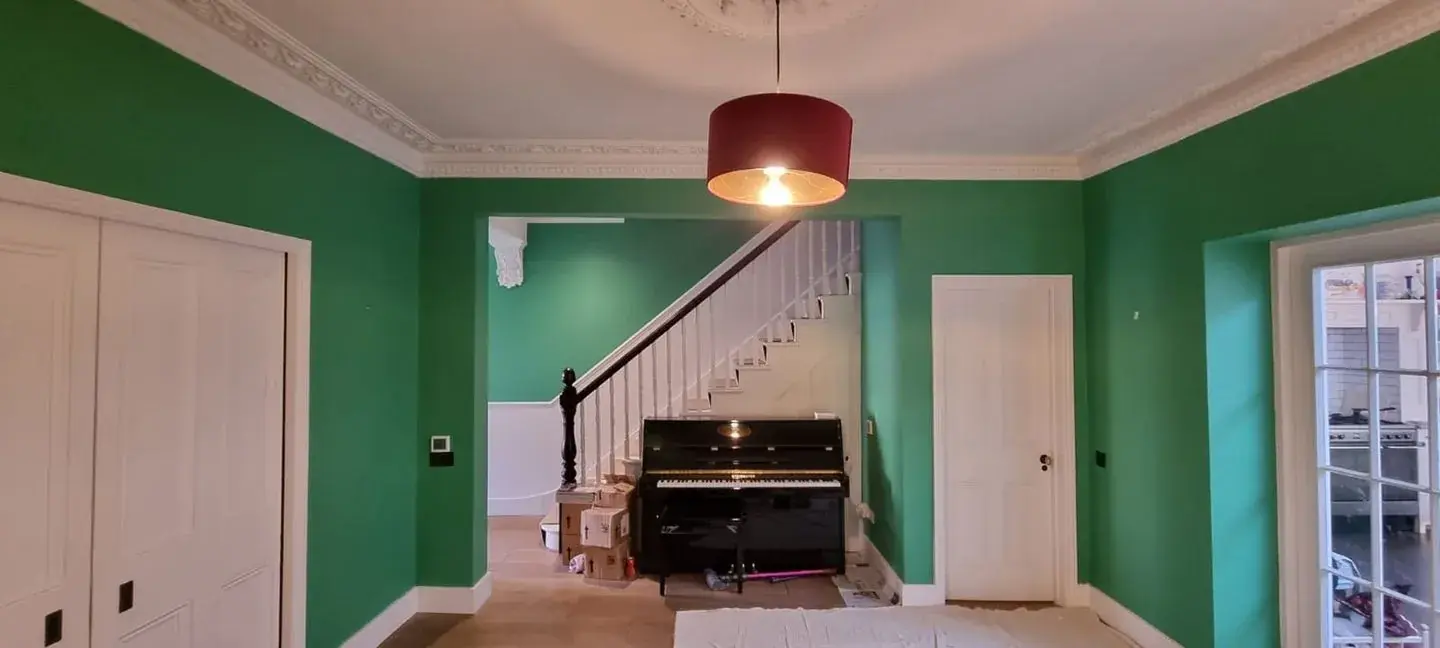
Get three quotes for the same job and you'll often see three very different numbers. One decorator comes in at £2,000, another at £4,500, and you're left wondering if the cheap one is cutting corners or the expensive one is taking you for a ride. Usually, it's neither. They're just pricing different amounts of prep, different paint, and different levels of care around your period features. Here's what actually goes into the number, so you can tell a fair quote from a guess.
The short answer
Typical West London ranges (2026)
Single room: £400–£700. Whole interior of a 3-bed house: £3,500–£6,000+. Full exterior repaint: £2,500–£5,000+ for a semi, more for detached or stucco-fronted properties. London typically runs 30–40% above the UK national average, and period properties with communal access or scaffolding requirements sit at the higher end.
Those are starting points, not quotes. The only way to get an accurate figure is to have someone walk the property, because two houses on the same street can cost completely different amounts depending on condition.
| Job | Typical West London price | Typical duration |
|---|---|---|
| Single bedroom or bathroom | £400–£550 | 1–2 days |
| Living room or kitchen | £550–£800 | 1–2 days |
| Full 3-bed house interior | £3,500–£6,000 | 5–8 days |
| Front elevation (2-storey semi) | £400–£900 | 2–3 days |
| Full exterior repaint | £2,500–£5,000+ | 1–2 weeks |
| Stucco or render repair + repaint | £3,500–£7,000+ | 2–3 weeks |
Interior painting costs
For a single room, most decorators in West London will charge somewhere between £400 and £700 including labour and materials, depending on size, ceiling height and how much filling and sanding the walls need before a brush even goes near them. Three rooms together usually come to £1,200–£2,000, and a full interior repaint on a typical 3-bed house lands around £3,500–£6,000.
- ✓Small bedroom or bathroom: £400–£550
- ✓Living room or kitchen (larger, more cutting-in around fixtures): £550–£800
- ✓Full 3-bed house interior: £3,500–£6,000
- ✓Period features (cornicing, panelling, sash windows): add 15–25%
Exterior painting costs
Exterior work is priced more by area than by room, and the national average sits around £20–£40 per square metre for masonry paint over two coats. In practice, that works out to roughly £400–£900 for a front elevation on a two-storey semi, £1,000–£3,000 for a full exterior including upper floors, and £2,500–£5,000+ for a typical semi-detached house end to end.
If your property has stucco or render, which describes half of Notting Hill and plenty of Holland Park, budget more. Stucco holds cracks and blown patches that need proper repair before painting, not just a quick fill, and skipping that step is exactly how a paint job starts flaking within eighteen months.
What actually moves the price
The paint itself is rarely the expensive part. It's everything that happens before the paint goes on, and it's usually only 15–25% of the total job cost. Here's where the rest goes.
Prepping surfaces: the hidden cost
On paper, prep is filling, sanding and priming. On a period property, it's often the majority of the job. Old flaking layers need to be scraped back rather than painted over, damp staining needs treating at the source or it bleeds straight through fresh paint within weeks, and original plaster cornicing needs careful masking rather than the quick cut-in you'd use on a flat modern ceiling. A wall that looks fine from across the room can still need two hours of work before a brush touches it. This is the single biggest reason two quotes for the same room can differ by hundreds of pounds: one decorator has priced a proper scrape-and-prime, the other has priced painting over what's already there.
Scaffolding and access
Anything above what a standard ladder or tower can safely reach needs scaffolding, and that's most three-storey Victorian and Edwardian terraces in Kensington, Chiswick and Ealing. Scaffold hire typically runs £500–£1,200 for a week depending on the height and how much of the facade it needs to wrap, and it has to go up before painting starts and come down after, which adds time as well as cost. Some properties can get away with a mobile tower for lower sections, which is considerably cheaper, but a full three-storey front elevation almost always needs proper scaffolding to be done safely and to a decent standard.
Materials and consumables
Beyond the tin of paint, most quotes include primer, filler, caulk and masking materials, and on older properties a stabilising solution for chalky or powdery masonry before anything else goes on. A premium masonry or trade paint (Dulux Weathershield, Little Greene, Farrow & Ball exterior ranges) costs more per tin than a budget alternative, but it holds colour and resists cracking for longer, which matters more the harder your surfaces are to reach. On a scaffolded job, paying more for paint that lasts eight years instead of four is usually the cheaper decision over time, since you're not paying for scaffolding twice.
- ✓Occupied vs empty: working around furniture, tenants or a family still living there takes longer than an empty property
- ✓Communal considerations: buildings with residents’ associations or garden squares sometimes need sign-off or specific working hours, which affects scheduling more than price directly
- ✓Number of coats: most jobs need two full coats for even coverage; a single coat over a colour change often shows patchiness within months
- ✓Woodwork and trim: gloss work on skirting, doors and sash windows is priced separately from wall painting and adds meaningfully to a full-room quote
Why West London costs more than the UK average
London running 30–40% above the national average isn't just a London tax. A lot of it comes down to the housing stock. Victorian and Edwardian terraces, mansion flats and stucco-fronted townhouses need more careful prep and higher-spec materials than a modern new-build, and clients in areas like Kensington, Chiswick and Barnes are generally decorating to a higher standard than a quick refresh, which pushes both time and material costs up.
Day rates: what you're actually paying for
If a quote is priced by time rather than by job, expect a day rate somewhere between £250 and £400 for an experienced decorator, with £325 being about average nationally. London rates sit above that. What you're paying for at the higher end isn't just paint application, it's someone who preps properly, protects your floors and furniture, and doesn't leave you with visible brush marks six months later.
DIY or hire a professional?
It depends entirely on what you're painting, not on confidence with a roller. A single low-risk room with good access and no colour correction is a genuinely reasonable weekend DIY project, and the material cost alone (paint, brushes, filler, tape) usually comes to under £150. Where DIY gets expensive is everything else: anything above ground-floor height, stucco or render repair, colour changes that need extra coats to cover properly, and period woodwork or cornicing where a slip with the brush means redoing plasterwork, not just touching up paint. We've been called in more than once to fix a DIY exterior job where paint was applied over damp or unstable render, and the redo cost more than a professional job would have from the start. If it's one room and you enjoy it, do it yourself. If it involves height, period detailing, or a finish you want to last a decade, the prep work is where the money is best spent.
How to get an accurate quote
Skip the phone-quote. Any number given without someone seeing the property is a guess, and guesses tend to be wrong in the decorator's favour once they arrive and see the actual condition. A proper quote should include a site visit, a breakdown of prep versus painting, and the specific paint brand and finish being used, not just a total figure.
If you'd rather skip the guesswork entirely, send us a few photos and some basic details about the property and we'll give you a clear, itemised quote, no inflated call-out fee, no vague lump sum.